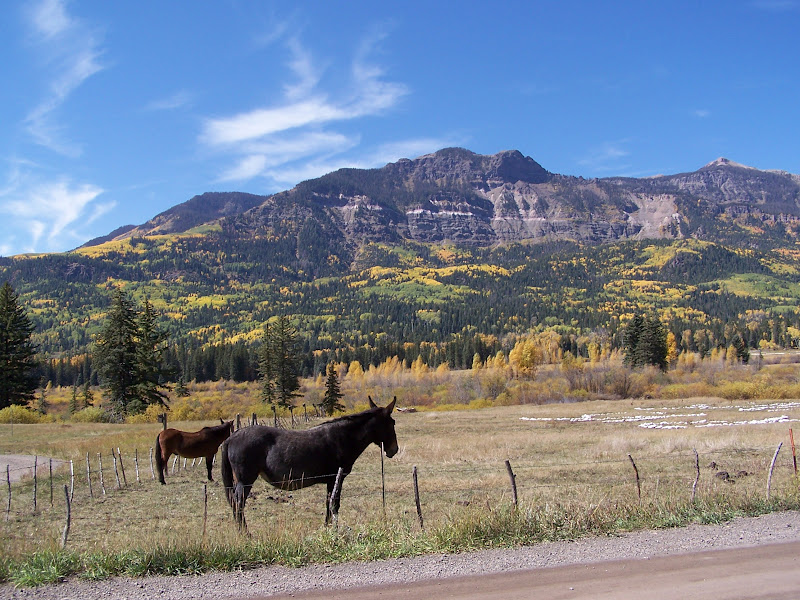
OUR DRIVE THROUGH SOUTHERN COLORADO from Cortez to Alamosa was easily the most beautiful drive we have taken on our trip. The Aspens are beginning to change colors, and their yellow intermingled among the Spruce made an interesting contrast.
We stopped briefly at the Bruce Spruce Ranch, a place our daughter and her husband had stayed last year. Although we had planned to stay there tomorrow night, our change in plans meant that we would have to cancel our reservation. Since we were driving right by the ranch, we decided to cancel in person. When we saw the ranch, we were sorry we had to cancel.
It looks like we are finally getting out of Indian Country. Ever since we hit South Dakota, we have been constantly reminded of the hundreds of movies and TV shows we have seen over the years dealing with the Indians west of the Mississippi. For people who have never read any history, it must appear that the only Indian wars were those west of the Mississippi. Those people would be surprised to learn that more Whites were killed by Indians east of the Mississippi than in all of the massacres and Indian wars west of the Mississippi.
Throughout the 1600s and into the early 1800s, people in the East were often at war with a number of different Indian tribes, including the Iroquois (later the Iroquois Confederation) and the Shawnee. In Pennsylvania alone there was the French and Indian War, Pontiac's War, Lord Dunmore's War, the Revolutionary War, and the Indian uprising from 1789 to 1795. My Scots-Irish ancestors in Pennsylvania gave as good as they got. The gentle Quakers who ran the state were shocked at reports of Scots-Irish scalping Indians and perpetrating massacres of Indian villages. You won't find many movies on this chapter of American history. John Ford's classic Drums along the Mohawk is one of the few films dealing with an Indian war east of the Mississippi.
Why has Hollywood ignored the eastern Indians and their numerous killings and massacres?
I have always blamed James Fenimore Cooper for Hollywood's avoidance of such savage Indians as the Iroquois and the Mohawk. Like every kid who has attended high school, Hollywood directors and producers were forced to read one or more of Cooper's turgid Leatherstocking Tales, and probably remembered how boring those stories were. Cooper was popular in his day solely because he was the only person writing about frontiersmen and Indians: "In the country of the blind, the one-eyed man is king."
In the fullness of time, people began to recognize the short-comings of Cooper's novels. In 1895, Mark Twain published his famous essay on one of Cooper's books. Twain asserted that Cooper's popular The Deerslayer, a
Leatherstocking tale, committed 114 "offenses against literary art out of a
possible 115."
Hollywood should at least have made a movie about the charismatic Tecumseh. Uniting a number of Indian tribes in the early 1800s, he fought the Americans for years. When he was killed at the Battle of Thames in Canada, his united movement collapsed. Tecumseh remains the only person, White or Indian, responsible for two different political campaign slogans at the National level. In 1836, Richard Johnson, the man who supposedly killed Tecumseh, campaigned for Vice-President with the sadly forgotten campaign slogan
"Rumpsey Dumpsey, Rumpsey Dumpsey, Colonel Johnson Killed Tecumseh." Four years later, William Henry Harrison, who defeated a band of Tecumseh's supporters at Tippecanoe, Indiana, ran for president using the slogan "Tippecanoe and Tyler Too." History is so unfair, not a single movie about Tecumseh.
. . . through the eyes of Carole and Bruce Mackey--you'll have no problem determining the author of the various comments.
Thursday, October 4, 2012
Wednesday, October 3, 2012
October 2, 2012
WE HAD PLANNED TO GO TO MESA VERDI TODAY to see the ancient Anasazi ruins. The Anasazi lived in the Four Corners area around 2000 years ago, and not much is known about them. Actually, the political correctness boys have substituted the word "Puebloans" for Anasazi. After using the term Anasazi for over a hundred years, archeologists discovered that the word meant either "ancient enemies" or "ancient strangers." Supposedly, the Pueblo Indians find the word Anasazi to be offensive. I suppose it is something like the Indians versus Native Americans issue. Ironically, everywhere we have been in the West, Indians call themselves Indians. I suppose I will have to ask a Pueblo how he or she feels about the word Anasazi.
When we began to look into what was involved in visiting the Mesa Verde park, we found that we would have to drive 21 miles after we drove up a steep, narrow and winding road to see the first Anasazi dwelling. Once we got there, we would be able to see inside the dwelling by climbing a steep ladder. I convinced Carole that today should be a day of rest.
Part of the day was occupied with determining where we would go next. When Carole mentioned New Mexico, I balked. On any other trip, I would have readily agreed to visit New Mexico. So far on this trip, however, we have been bombarded with photos, posters and books about some of the West's so-called real bad boys. Most of these bad boys killed at most only one or two people. I knew that if we went to New Mexico, we would end up hearing and seeing way too much about Billy the Kid, another guy who does not deserve his reputation. Although almost every sentient human being thinks that they know all about Billy, most of what people have "learned" about him through movies or TV is dead wrong. For years, he was referred to as the "left-handed gun." In fact, Paul Newman portrayed him in a movie entitled "The Left-Handed Gun. Everyone "knew" he was left handed because of a an old tin-type photo which shows him to be left handed. Eventually, some unknown photographer explained that tin-types produced a mirror image. Today, at least, the image has been reversed to show that he was right-handed.
Even more galling is that books and movies have repeated the canard that he killed 21 men before he was 21 years old. In recent years, historians have concluded that he only killed between 3 and 5 men.
Compare Billy with John Wesley Hardin, a man who historians agree killed somewhere between 30 and 40 men. A real bad dude, he once killed a man for snoring. Having compiled such a bloody record, one would assume his name would be far more familiar than Billy the Kid. Yet, were it not for Bob Dylan's John Wesley Harding album, he would be a forgotten man today. History can be so unfair. Dylan spelled John Wesley's last name as "Harding," but Bob's heart was in the right place.
Carole relented on New Mexico, and we decided to drive east until we could find a road which would take us to northern Colorado.
When we began to look into what was involved in visiting the Mesa Verde park, we found that we would have to drive 21 miles after we drove up a steep, narrow and winding road to see the first Anasazi dwelling. Once we got there, we would be able to see inside the dwelling by climbing a steep ladder. I convinced Carole that today should be a day of rest.
Part of the day was occupied with determining where we would go next. When Carole mentioned New Mexico, I balked. On any other trip, I would have readily agreed to visit New Mexico. So far on this trip, however, we have been bombarded with photos, posters and books about some of the West's so-called real bad boys. Most of these bad boys killed at most only one or two people. I knew that if we went to New Mexico, we would end up hearing and seeing way too much about Billy the Kid, another guy who does not deserve his reputation. Although almost every sentient human being thinks that they know all about Billy, most of what people have "learned" about him through movies or TV is dead wrong. For years, he was referred to as the "left-handed gun." In fact, Paul Newman portrayed him in a movie entitled "The Left-Handed Gun. Everyone "knew" he was left handed because of a an old tin-type photo which shows him to be left handed. Eventually, some unknown photographer explained that tin-types produced a mirror image. Today, at least, the image has been reversed to show that he was right-handed.
Even more galling is that books and movies have repeated the canard that he killed 21 men before he was 21 years old. In recent years, historians have concluded that he only killed between 3 and 5 men.
Compare Billy with John Wesley Hardin, a man who historians agree killed somewhere between 30 and 40 men. A real bad dude, he once killed a man for snoring. Having compiled such a bloody record, one would assume his name would be far more familiar than Billy the Kid. Yet, were it not for Bob Dylan's John Wesley Harding album, he would be a forgotten man today. History can be so unfair. Dylan spelled John Wesley's last name as "Harding," but Bob's heart was in the right place.
Carole relented on New Mexico, and we decided to drive east until we could find a road which would take us to northern Colorado.
Tuesday, October 2, 2012
October 1, 2012
CAROLE AND I HAVE LONG BEEN FANS OF JOHN FORD, particularly his westerns. Today, we drove through Monument Valley where he filmed seven of his most famous westerns, including Stagecoach and She Wore a Yellow Ribbon. Monument Valley is located in both Arizona and Utah, near the Four Corners. John Ford's first western shot in the valley was Stagecoach, a film that made John Wayne famous and won two Oscars. When Wayne saw the valley for the first time, he supposedly said: "So this is where God decided to locate the West."
Monument Valley is not a national park, but is owned and run by the Navajo. After paying a nominal ten dollar entrance fee, we proceeded to the visitors' center to obtain a map for a self-guided tour. We had done our homework and knew that there was a 17 mile drive along a rough, unpaved road which made a loop through the valley. Many visitors prefer to hire someone to drive them through the valley, but we trusted the Durango to take us through.
On our way to obtain a map, we found ourselves in a room dedicated to the famous Code Talkers of WWII. The contents of the room were interesting. In addition to information about the Code Talkers, the room displayed a brief history of WWII. Starting with the "sneak attack" on Pearl Harbor and ending with the bombings of Hiroshima and Nagasaki, the various signs and photos gave a brief summary of the war and showed how the Code Talkers were first formed and how they operated.
It was difficult to concentrate in the room, however. A large, obnoxious group of foreigners decided to use the room to yell at each other. For some reason, they showed little interest in the information displayed in the room. When they left, I said to Carole: " You would think that they would have had some interest in learning why they were not able to break the code."
After we obtained the map, we took off on our drive. The speed limit was 15 miles an hour, but the road was so bad that we only got up to 15 miles an hour for short stretches. As we anticipated, the views were incredible.
I could picture Ben Johnson racing his horse Laddie away from pursuing Indians in She Wore a Yellow Ribbon. It was somewhat more difficult picturing John Wayne riding through the valley in The Searchers, a movie supposedly set in Texas.
Monument Valley is not a national park, but is owned and run by the Navajo. After paying a nominal ten dollar entrance fee, we proceeded to the visitors' center to obtain a map for a self-guided tour. We had done our homework and knew that there was a 17 mile drive along a rough, unpaved road which made a loop through the valley. Many visitors prefer to hire someone to drive them through the valley, but we trusted the Durango to take us through.
On our way to obtain a map, we found ourselves in a room dedicated to the famous Code Talkers of WWII. The contents of the room were interesting. In addition to information about the Code Talkers, the room displayed a brief history of WWII. Starting with the "sneak attack" on Pearl Harbor and ending with the bombings of Hiroshima and Nagasaki, the various signs and photos gave a brief summary of the war and showed how the Code Talkers were first formed and how they operated.
It was difficult to concentrate in the room, however. A large, obnoxious group of foreigners decided to use the room to yell at each other. For some reason, they showed little interest in the information displayed in the room. When they left, I said to Carole: " You would think that they would have had some interest in learning why they were not able to break the code."
After we obtained the map, we took off on our drive. The speed limit was 15 miles an hour, but the road was so bad that we only got up to 15 miles an hour for short stretches. As we anticipated, the views were incredible.
I could picture Ben Johnson racing his horse Laddie away from pursuing Indians in She Wore a Yellow Ribbon. It was somewhat more difficult picturing John Wayne riding through the valley in The Searchers, a movie supposedly set in Texas.
Sunday, September 30, 2012
September 30, 2012
I HAD EATEN IN THE MOTEL'S RESTAURANT THE NIGHT BEFORE and was not impressed. Accordingly we decided to go to another restaurant for breakfast. I ordered three pancakes, but the waitress tried to talk me into a smaller order. She claimed that the pancakes were very large. Because three pancakes cost only six bucks, I figured that they couldn't be too big. When the order came, it looked like a stack of frisbees. I managed to make it through about half of them.
We tried to find a sports bar in town so that Carole could watch the Packers, but sports bars have not made their way into this corner of the world. Thinking that we might find a place where Carole could watch the Packers play near Monument Valley, we left Page around noon. Our destination was Kayenta, a town near Monument Valley. We didn't fill our tank with gas because our map showed that there were several towns on our route. When the gas tank was near empty, we saw a sign for one of the towns. What was labelled a town on our map turned out to be a collection of rusty trailers, but no gas station. The next "town" we saw looked just like the first one. With no town within 40 miles, and our gas tank on empty, we began practicing saying ya'at'eeh in case we met one of the locals who might have some gas. Suddenly, seemingly out of nowhere, a gas station appeared and we were able to fill our tank.
When we arrived in Kayenta, we discovered that it did not have a sports bar; so Carole sat in the Durango and listened to the game on Satellite radio; that's devotion. I was afraid she would burn up a tank of gas, but she told me that she used up only a quarter of a tank. In pellucid logic, she explained that using up a quarter of a tank of gas was cheaper than buying a ticket to a game. At least the Packers won.
While Carole was listening to the game, I amused myself by reading the local phone book. Because there are so few people living in the area, the phone book covers a wide area. When Carole came back to the room, I told her that we had to visit a town in Utah named Fredonia. Frankly, I was surprised when she inquired as to why I wanted to visit this town with a hallowed name. I patiently explained to Carole why I wanted to visit Fredonia: "Don't you remember the classic Marx Brothers' film Duck Soup, and Groucho singing "Hail Fredonia? Groucho, AKA Rufus T. Firefly, was the president of Fredonia during its war with a neighboring country."
We saw a sign indicating that there was a museum in the area dedicated to the Navajo code talkers who baffled the Japanese during WWII. We decided to pass up the museum. After all, our oldest daughter and I have been talking in code for years. No one has ever been able to break our code. In fact, most people don't even know we are talking in code.
We tried to find a sports bar in town so that Carole could watch the Packers, but sports bars have not made their way into this corner of the world. Thinking that we might find a place where Carole could watch the Packers play near Monument Valley, we left Page around noon. Our destination was Kayenta, a town near Monument Valley. We didn't fill our tank with gas because our map showed that there were several towns on our route. When the gas tank was near empty, we saw a sign for one of the towns. What was labelled a town on our map turned out to be a collection of rusty trailers, but no gas station. The next "town" we saw looked just like the first one. With no town within 40 miles, and our gas tank on empty, we began practicing saying ya'at'eeh in case we met one of the locals who might have some gas. Suddenly, seemingly out of nowhere, a gas station appeared and we were able to fill our tank.
When we arrived in Kayenta, we discovered that it did not have a sports bar; so Carole sat in the Durango and listened to the game on Satellite radio; that's devotion. I was afraid she would burn up a tank of gas, but she told me that she used up only a quarter of a tank. In pellucid logic, she explained that using up a quarter of a tank of gas was cheaper than buying a ticket to a game. At least the Packers won.
While Carole was listening to the game, I amused myself by reading the local phone book. Because there are so few people living in the area, the phone book covers a wide area. When Carole came back to the room, I told her that we had to visit a town in Utah named Fredonia. Frankly, I was surprised when she inquired as to why I wanted to visit this town with a hallowed name. I patiently explained to Carole why I wanted to visit Fredonia: "Don't you remember the classic Marx Brothers' film Duck Soup, and Groucho singing "Hail Fredonia? Groucho, AKA Rufus T. Firefly, was the president of Fredonia during its war with a neighboring country."
We saw a sign indicating that there was a museum in the area dedicated to the Navajo code talkers who baffled the Japanese during WWII. We decided to pass up the museum. After all, our oldest daughter and I have been talking in code for years. No one has ever been able to break our code. In fact, most people don't even know we are talking in code.
September 29, 2012
WE LEFT CANYON VILLAGE THIS MORNING to go to Lake Powell. We may have left Canyon Village, but we didn't leave the canyon: it was in sight for nearly fifty miles. The Colorado River starts at Lake Powell, and flows southward before bending westward to flow through the canyon. It was a clear day, and we could see Navajo Mountain over 90 miles in the distance.
After stopping several times to see the canyon from different angles, we finally reached the end of the canyon.
Not far from the east entrance is a watch tower which affords a commanding view of the canyon. I resisted the urge to climb the tower.
Once out of the park, we skirted the edge of a large Navajo reservation where the late Tony Hillerman set most of his mysteries. At one point, we drove within a few miles of Tuba City, a headquarters for the Navajo police frequented by Jimmy Chee and Joe Leaphorn, Hillerman's leading two detectives. Throughout our drive, we could see the abject poverty of the Indians just as Hillerman had described in his novels. Many of The Navajos live in old trailers and have erected wooden stands by the highway to sell blankets. When we reached the motel, we were happy to see that most of the employees are Navajo.
Page, the town at Lake Powell, is much more up-scale than most of the towns we have seen in the last several weeks. The canyon rafting trips start here, and the lake is a very popular spot for house boating.
After stopping several times to see the canyon from different angles, we finally reached the end of the canyon.
Not far from the east entrance is a watch tower which affords a commanding view of the canyon. I resisted the urge to climb the tower.
Once out of the park, we skirted the edge of a large Navajo reservation where the late Tony Hillerman set most of his mysteries. At one point, we drove within a few miles of Tuba City, a headquarters for the Navajo police frequented by Jimmy Chee and Joe Leaphorn, Hillerman's leading two detectives. Throughout our drive, we could see the abject poverty of the Indians just as Hillerman had described in his novels. Many of The Navajos live in old trailers and have erected wooden stands by the highway to sell blankets. When we reached the motel, we were happy to see that most of the employees are Navajo.
Page, the town at Lake Powell, is much more up-scale than most of the towns we have seen in the last several weeks. The canyon rafting trips start here, and the lake is a very popular spot for house boating.
Friday, September 28, 2012
September 28, 2012
WHEN WE RECEIVED AN EMAIL FROM OUR DAUGHTER to the effect
that she and her husband could not take off work to meet us at Lake Powell, we
spent some time this morning plotting out several new destinations in Colorado. After again walking along the rim and viewing
the canyon, we decided to search out another ranger talk. Since we hadn’t heard one on elk, we decided
to attend one in the early afternoon.
On our way to the ranger talk on elk, our bus was held up by
a slow moving elk. During the ranger
talk, we heard again that elk are in rut and are unpredictable. Their massive antlers can weigh as much as 80
pounds. Ironically, elks normally do not
have to use their antlers in fights. In
most cases, a mere “show of force” will scare off smaller competitor elks. If they do engage in fights, they run both
the risk of becoming entangled with other elk antlers or suffering severe gashes.
Later in the day, we attended a ranger talk on California Condors, the largest bird in the United States. Faced with extinction a few years ago, the condors have made a remarkable comeback. Enlisting the assistance of scientists and hunters, the Park Service has inserted into the park birds born in captivity. From a low of 22 condors when they were first recognized as endangered, they now number over 400 worldwide. Grand Canyon, alone, has 87 condors. They are often confused with Turkey Vultures, but their wing-span of over 9 feet should be a dead giveaway. Although the ranger did not mention it, I came to a conclusion about both Turkey Vultures and California Condors: they are both really ugly birds.
September 27, 2012
OUR TRAIN RIDE/OVERNIGHT STAY had given us enough of an
overview of Canyon Village that we knew how to get around Canyon
Village. Because the shuttle buses are color coded, a practice we had first
encountered years ago in the London Underground, it was easy to get to wherever
you wanted to go: determine the color of the “line” where your destination is
located and get on a bus marked with that color. We decided to check out a geology
museum. It wasn’t much of a museum, but
had a huge window offering a broad view of the canyon. On a shelf near the window, the Park had
placed at least a dozen high-power binoculars. A convenient map indicated points of interest in the canyon. We could see where a number of rafters had
pulled ashore, and could make out the location of the Phantom Ranch. With the zoom lens on my camera, the photo I took made some rafters look closer than the two miles away they had pulled their rafts ashore.
During the balance of the day, we ambled along the rim and viewed the canyon from a variety of vantage points. As we walked along the rim, we noticed that as Americans we were minorities. I was waiting for one of the Italians to start talking to Carole, but it didn’t happen. Early fall is a popular time for foreigners to visit the West.
Tired of eating sandwiches, we had dinner in the Arizona Room in the Bright Angel Lodge. In addition to a Caesar Salad, I ordered a huge “sampler” which included filet, ribs, chicken, green beans, and baked potatoes. Carole ordered a Rib Eye served with a shrimp topping.
The night ranger program was conducted by a guy who had been
a ranger for around thirty years, and his experience showed. He had some title to his program, but
answered questions on numerous topics. He
mentioned that while cougars are rare in the park, a tracking camera had once
filmed one in the park several minutes after two rangers had passed the same
site.
Oddly enough, squirrels account for the largest number of animal attacks in the park. Despite warnings not to feed them and further warnings that squirrels can transmit a form of the plague, an average of one person is bitten by a squirrel. In each case, a tourist was feeding the squirrel.
Subscribe to:
Posts (Atom)


